
 Austria
 Belgium
 Denmark
 Finland
 France
 Germany
 Greece
 Iceland
 Ireland
 Liechtenstein
 Netherlands
 Norway
 Poland
 Portugal
 Spain
Spain
 Sweden
 Switzerland
 Turkey
 United Kingdom
 Australia
 Fiji
Fiji
 Hong Kong
 India
India
 Indonesia
 Japan
Japan
 Malaysia
 New Zealand
 Philippines
 Singapore
 Thailand
 Brazil
 Chile
Chile
 Colombia
 Mexico
 Peru
Peru
 USA
USA
 Bahrain
 Israel
 Morocco
 Oman
Oman
 UAE
UAE
 Saudi Arabia
 Tanzania
Health Social Protection: how does France position itself in global trends?
 Prefer us on Google


Howden publishes its new 2026 Social Protection report "The changing face of global employee health", a thorough analysis of international trends that redefine health and welfare in business.
Thanks to our global presence and local expertise, we were able to compare the specificities of the French market to global trends: constant medical inflation, mental health issues, employee expectations regarding complementary health and welfare benefits from their company.

The French exception: controlled inflation in 2026
The projected medical trend for 2026 in France is +5%, significantly lower than the European average (+8.5%) and global average (+10.6%), with an estimated inflation of +1.5%. These increases in contributions for companies are becoming increasingly difficult to absorb when the employer contribution is mandatory and already represents 3 to 5% of the payroll. The situation is exacerbated by:
- Frequent regulatory and tax adjustments,
- A progressive transfer of certain public costs to complementary health insurance,
- Demographic trends: declining birth rates, aging workforce, and an increase in chronic diseases.
Faced with these pressures, companies renegotiate their contracts more frequently, adjust their participation scales when possible, and intensify their investments in prevention, digital access to care, and workplace health programs.
Access to healthcare: waiting times are increasing for employees
If the quality of the French public health system is no longer to be demonstrated, delays in access vary greatly depending on the place of residence. Employees in rural areas struggle to obtain appointments, especially with specialists, and even some urban areas remain underserved, especially in dermatology and stomatology.
This issue is not only French. At the European level, waiting times represent a major challenge: 21% of European employees wait more than a month for a first medical appointment, compared to only 6% in the Pacific region. France is part of this European trend where health systems are under pressure.
To reduce these disparities, organizations are increasingly turning to digital solutions, such as teleconsultation, which allow employees to quickly access a doctor without having to travel. Private healthcare is also expanding: globally, 51% of employees now rely exclusively on private healthcare for their most serious treatments, a figure that reflects the increasing pressure on public healthcare systems.

New therapies: real benefits, but increasing complexity
Therapeutic advances - whether in oncology treatments, solutions for chronic diseases, or highly publicized GLP-1 medications - are transforming the healthcare landscape. Internationally, the cost of these new therapies concerns employers: 65% of global companies cite the increasing trend of GLP-1 medications as a financial concern, and 53% expect a 5 to 25% increase in costs related to diabetes and obesity by 2026.
In France, their prescription and their reimbursement are strictly regulated. That is why expenses related to GLP-1 remain contained to this day, unlike in other European countries.
Companies must clarify the boundaries between services reimbursed by Social Security and guarantees under collective contracts, in order to anticipate financial commitments and avoid unpleasant surprises. Care pathways are lengthening, particularly for chronic diseases, blurring the boundaries between health insurance, disability management, and support for return to work.

Technology is transforming access to healthcare
Digital health is now essential: teleconsultation, support platforms, digital prevention... These tools address a dual challenge: reduce access delays and better support employees in their journey. Employers see this as a way to reduce territorial inequalities and limit absences for routine consultations.
Artificial intelligence is also disrupting the sector: 68% of employees worldwide declare that they trust AI in their healthcare journey, especially for diagnostics, treatments, and managing reimbursement requests. On the employers' side, 48% wish to see AI adopted more widely, mainly for intelligent diagnostics (45%), processing reimbursement requests (37%), and predictive analysis of high-cost claims (37%).
The digital allows to better guide employees, help them understand their benefits, and promote prevention. Some companies even organize awareness or screening days on site through providers, with an adoption rate variable depending on the sectors and the size of the organizations.
The main issue remains integration: these tools are not truly effective unless they are part of a coherent and well-explained process, rather than just a collection of isolated solutions.
Digital tools are reshaping the healthcare journey, making it simpler and more seamless, and require regular communication to increase their usage.
Mental health: an issue still marked by stigma
Mental health has become one of the leading factors of absenteeism in the world. Stress, anxiety, and psychosocial risks now affect all categories of employees, with a high prevalence among young people. International figures confirm the extent of the phenomenon: 49% of employees worldwide sought mental health support last year. Employers identify mental health as the main risk factor for 2026 and the biggest contributor to the costs of their health plans. However, 18% of employees surveyed hesitate to use the devices offered by their employer, fearing stigma (38%), impact on their career (39%), or lack of confidentiality (38%).
If the State strengthens public services in France (My Support Psy), they do not always cover all costs, especially in large cities where prices are higher. Consequently, employers often have to finance additional sessions or more comprehensive programs.
Confidentiality remains a central element, ensuring trust from employees while limiting employers' visibility on trends. Financially, absences related to mental health become a significant burden, fueling debates around sick leave or the evolution of insurance schemes.
Mental health deserves as accessible services as those implemented for physical health. By 2025, the integration of mental health coverage is no longer an option.
The strategic importance of health plans for retention
Beyond health issues, collective schemes have become a strategic lever for loyalty and attractiveness of talents.
The employer must take the necessary measures to ensure the safety of employees and protect their health, both physical and mental. In this regard, 90% of employers surveyed believe that their health and welfare program meets the needs of their employees in terms of health and welfare. 74% even believe that a good health program contributes to talent retention, 63% that it maximizes productivity, and 55% that it helps attract new employees. However, at the same time, 25% of employees consider that they do not feel supported by their company in terms of health. In view of these figures, it is not surprising that 60% of employees declare that they are more likely to stay with an employer offering a solid complementary health program, and 49% affirm that this influences their decision when job searching.
In a tense labor market, these figures confirm that health is no longer a peripheral advantage but a pillar of employer value proposition.
How to better manage your health strategy?
To navigate in this complex landscape, French employers must combine three levers:
- Cost control: analysis of spending factors and anticipation of international trends
- Access to care: integration of digital, teleconsultations, structured prevention
- Clarity and support: communication with employees, understanding of reimbursement rules, management of new therapies
With its local expertise and proactive approach, Howden goes beyond simple contract management: we help employers transform their Social Protection programs into sustainable performance drivers.
Our global presence allows us to:
- Compare practices French compared to to international standards
- Negotiate with with insurers by relying on our weight and our knowledge in-depth of the European and global markets
- Anticipate emerging trends (AI, new treatments, mental health) before they impact budgets
- Identify some proven solutions in other countries and adaptable to the French context
Anticipating regulatory developments, optimizing guarantees, and integrating innovative solutions and services, Howden enables organizations to control their costs while enhancing the well-being of employees. Our mission is to build resilient, compliant, and sustainable social protection strategies that support the productivity and competitiveness of businesses in France - drawing on expertise that goes far beyond the borders of the Hexagon.
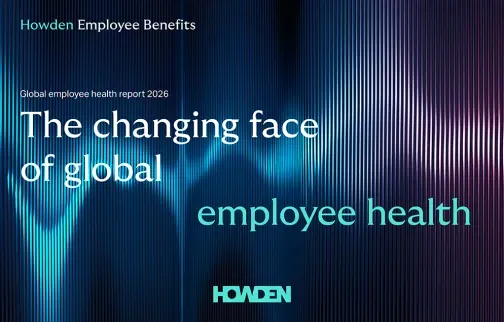
For more information, download the report
The changing face of global employee health