
 Austria
 Belgium
 Denmark
 Estonia
 Finland
 France
 Germany
 Greece
 Iceland
 Ireland
 Italy
Italy
 Liechtenstein
 Netherland
 Norway
 Poland
 Portugal
 Spain
Spain
 Sweden
 Switzerland
 Turkey
 United Kingdom
 Australia
 Fiji
Fiji
 Hong Kong
 India
India
 New Zealand
 Indonesia
 Japan
Japan
 Malaysia
 Philippines
 Singapore
 Thailand
 Brazil
 Chile
Chile
 Colombia
 Mexico
 Peru
Peru
 USA
USA
 Bahrain
 Israel
 Morocco
 Oman
Oman
 Saudi Arabia
 Tanzania
 UAE
UAE
PFAS in the Australian food & beverage industry: insurance risks in a rapidly shifting landscape
 Prefer us on Google


Perfluoroalkyl and polyfluoroalkyl substances (PFAS) have become a critical focus for regulators, insurers, and food & beverage (F&B) businesses across Australia.
Long valued for their non‑stick, grease‑resistant, and water‑repellent qualities, PFAS are now driving profound shifts in liability exposure, regulatory compliance, and insurance market behaviour. With the introduction of sweeping national bans, tightened water standards, and heightened public scrutiny, PFAS have evolved from an emerging hazard into a significant commercial risk - particularly for the F&B sector, which relies heavily on packaging materials, water quality, and complex supply chains.
What are PFAS?
PFAS are a large, complex group of synthetic chemicals "forever chemicals" that have been used in consumer products since the 1940s. They are ingredients in various everyday products from keeping food from sticking to packaging or cookware, making clothes and carpets resistant to stains, and creating firefighting foam that is more effective. PFAS molecules have a chain of linked carbon and fluorine atoms. Because the carbon-fluorine bond is one of the strongest, these chemicals do not degrade easily in the environment and can accumulate in human blood.
How PFAS enter the food & beverage supply chain in Australia
Because PFAS persist in soil, water, and the human body, long‑term accumulation raises both health concerns and reputational risks. While the presence of PFAS in the F&B industry is not yet regulated in all food & drink categories, authorities are closely monitoring the possibilities and ways PFAS can migrate into the food we consume. Some health studies have identified a potential link between PFAS exposure and thyroid issues, immune system impacts, pregnancy complications and some cancers1.
Pathways of contamination
- Environmental contamination: PFAS released from industrial sites, firefighting foams, landfills, and wastewater systems can contaminate soil, air, and water - ultimately affecting food production. International studies have detected PFAS in seafood, meat, dairy, and fresh produce, highlighting risks across multiple food categories.
- Food packaging migration: Historically, PFAS were common in grease‑resistant packaging such as takeaway containers, fast‑food wrappers, pizza boxes, and microwave popcorn bags. These materials can transfer PFAS into foods, particularly hot or fatty items.
- Processing equipment and cookware: PFAS‑containing coatings used on machinery or cooking surfaces may leach into foods during processing or storage.
- Food contact materials: The 2025 PFAS ban restricts PFAS use in many articles, including materials frequently used in food packaging. Suppliers must now transition away from PFAS‑coated papers, boards, and non‑stick surfaces.
What is the role of F&B companies?
For F&B companies, understanding but also managing the risks associated with PFAS is crucial and requires proactive measures to ensure product safety and consumer health. The first thought in terms of assessing the vulnerability of a company’s supply chain and finished products to PFAS contamination is to follow the laboratory testing route and analyse the findings to determine the risk. However, the challenge often lies in not knowing how to start. Testing for PFAS in many parts of the world is still almost prohibitively expensive and companies may be uncertain about which ingredients pose the highest risk. The uncertainty around this could potentially hinder the implementation of effective and proactive testing strategies.
Key operational exposures for F&B businesses
- Water used in processing, now subject to significantly tightened drinking water standards
- Packaging materials with potential residual PFAS content
- Contamination at former industrial or agricultural sites
- Imported ingredients or packaging from regions with weaker PFAS regulation
Australia’s Accelerating Regulatory Framework
Australia reached a major regulatory milestone on 1 July 2025, banning the manufacture, import, export, and use of PFOS, PFOA, and PFHxS – PFAS compounds historically used in packaging and coatings.
Litigation and Liability Trends in Australia
PFAS liability exposure in Australia is increasing significantly. PFAS is now a key liability risk, driven by:
- Major class actions, with settlements exceeding AUD345m2
- Greater attention from investors, community groups, and environmental advocates
- Global litigation activity, especially in the U.S., influencing local insurer expectations
For F&B companies, claims may arise from:
- Product contamination involving packaging or processing.
- Misleading or deceptive conduct tied to “natural,” “pure,” or “clean” marketing claims.
- Environmental contamination, especially groundwater impacts.
- Supply chain liability, including contamination originating from upstream suppliers.
- Even businesses unaware of PFAS in their operations may face legacy exposures due to historical contamination.
How are insurers in Australia responding to PFAS?
Australian insurers are tightening PFAS‑related underwriting and coverage:
- Increase in PFAS Exclusions: PFAS exclusions are appearing more frequently in environmental liability and general and products liability and policies.
- Increased underwriting scrutiny: Insurers now require detailed information on:
• Packaging materials and PFAS content
• Supplier controls and verification
• Water‑source testing and treatment
• PFAS assessments aligned with NEMP 3.03 (PFAS National Environmental Management Plan version 3.0)
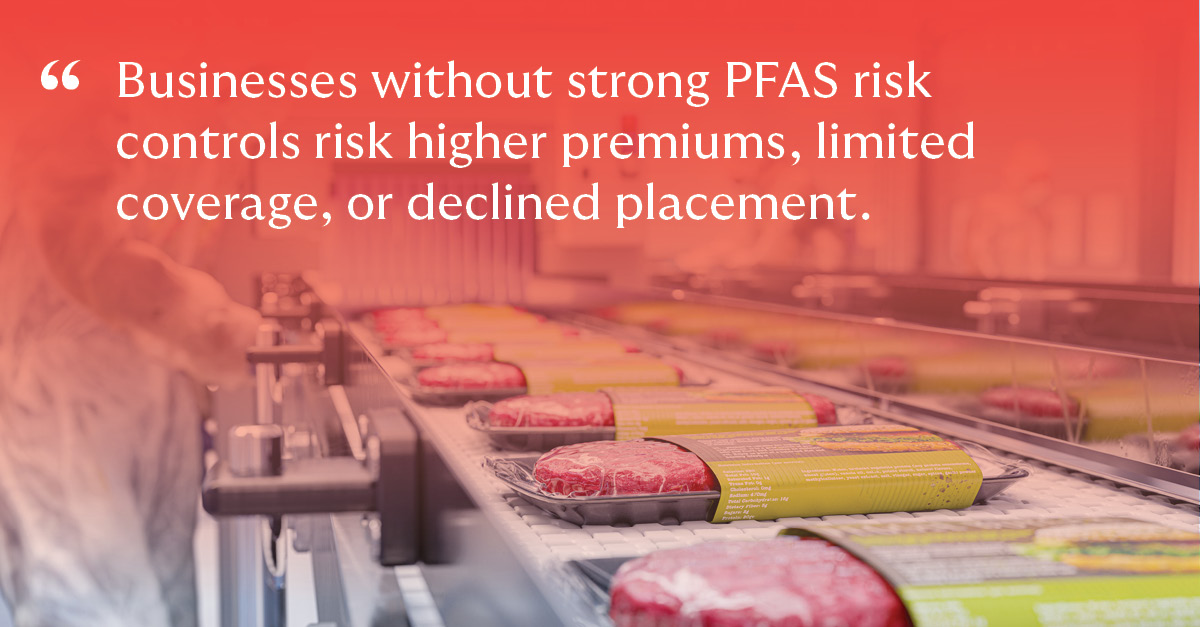
Businesses without strong PFAS risk controls risk higher premiums, limited coverage, or declined placement. - Environmental liability considerations: Site and groundwater contamination continue to drive environmental liability exposure and elevate the risk of long‑tail claims.
- ESG‑driven pressure: Insurers are increasingly influenced by ESG expectations, prompting closer evaluation of PFAS management throughout the supply chain.
Implications for F&B Businesses Seeking Insurance
To remain insurable and reduce PFAS‑related costs, F&B businesses should:
- Conduct a comprehensive PFAS supply chain audit: Assess packaging, food‑contact materials, cleaning agents, processing aids, and imported goods.
- Test water sources and implement treatment: Meet new national drinking water standards and document monitoring practices.
- Review marketing and labelling claims: Ensure claims such as “natural” or “chemical‑free” can withstand regulatory and legal scrutiny.
- Strengthen compliance and documentation: Insurers increasingly expect evidence of PFAS testing, supplier due diligence, NEMP 3.0 compliance, and transition plans away from banned PFAS chemicals.
- Engage brokers and insurers early: The tightening insurance market rewards businesses that proactively disclose PFAS risks and mitigation steps.
Conclusion
PFAS are now one of the most significant emerging risks for Australia’s F&B industry. With strict national bans, evolving standards for water and contamination, heightened community concern, and an increasingly cautious insurance market, PFAS exposure has become central to underwriting decisions. F&B businesses that take early, proactive steps to identify, assess, and mitigate PFAS risks will be best positioned to secure coverage, meet regulatory expectations, and protect long‑term operational resilience.
Should you require further information on this or wish to speak further in relation to PFAS, please reach out to your Howden representative to assist.