
 Austria
 Belgium
 Denmark
 Estonia
 Finland
 France
 Germany
 Greece
 Iceland
 Ireland
 Italy
Italy
 Liechtenstein
 Netherland
 Norway
 Poland
 Portugal
 Spain
Spain
 Sweden
 Switzerland
 Turkey
 United Kingdom
 Australia
 Fiji
Fiji
 Hong Kong
 India
India
 New Zealand
 Indonesia
 Japan
Japan
 Malaysia
 Philippines
 Singapore
 Thailand
 Brazil
 Chile
Chile
 Colombia
 Mexico
 Peru
Peru
 USA
USA
 Bahrain
 Israel
 Morocco
 Oman
Oman
 Saudi Arabia
 Tanzania
 UAE
UAE
Sustainability is redefining risk management in Australian agriculture
 Prefer us on Google


Sustainability has moved beyond environmental stewardship to a core risk management strategy for Australian businesses and nowhere is that more visible than in agriculture. As climate volatility intensifies, drought, extreme heat and rainfall variability events are now driving significant financial shocks, rather than isolated agricultural challenges. They can inhibit production, raise operating costs, and destabilise working capital. These pressures are exposing the limitations of traditional risk assumptions and forcing agribusinesses, lenders and insurers to rethink what resilience looks like.
As balance sheets come under pressure, sustainable farming practices such as improving water efficiency, soil resilience, energy use optimisation and diversifying production systems, are becoming essential to stabilising production, protecting insurability and laying foundations for the long-term viability of businesses. At the same time, insurers are reassessing underwriting appetites, regulators are expanding reporting obligations, and global supply chain disruptions are underscoring the importance of more integrated, forward‑looking risk management strategies.
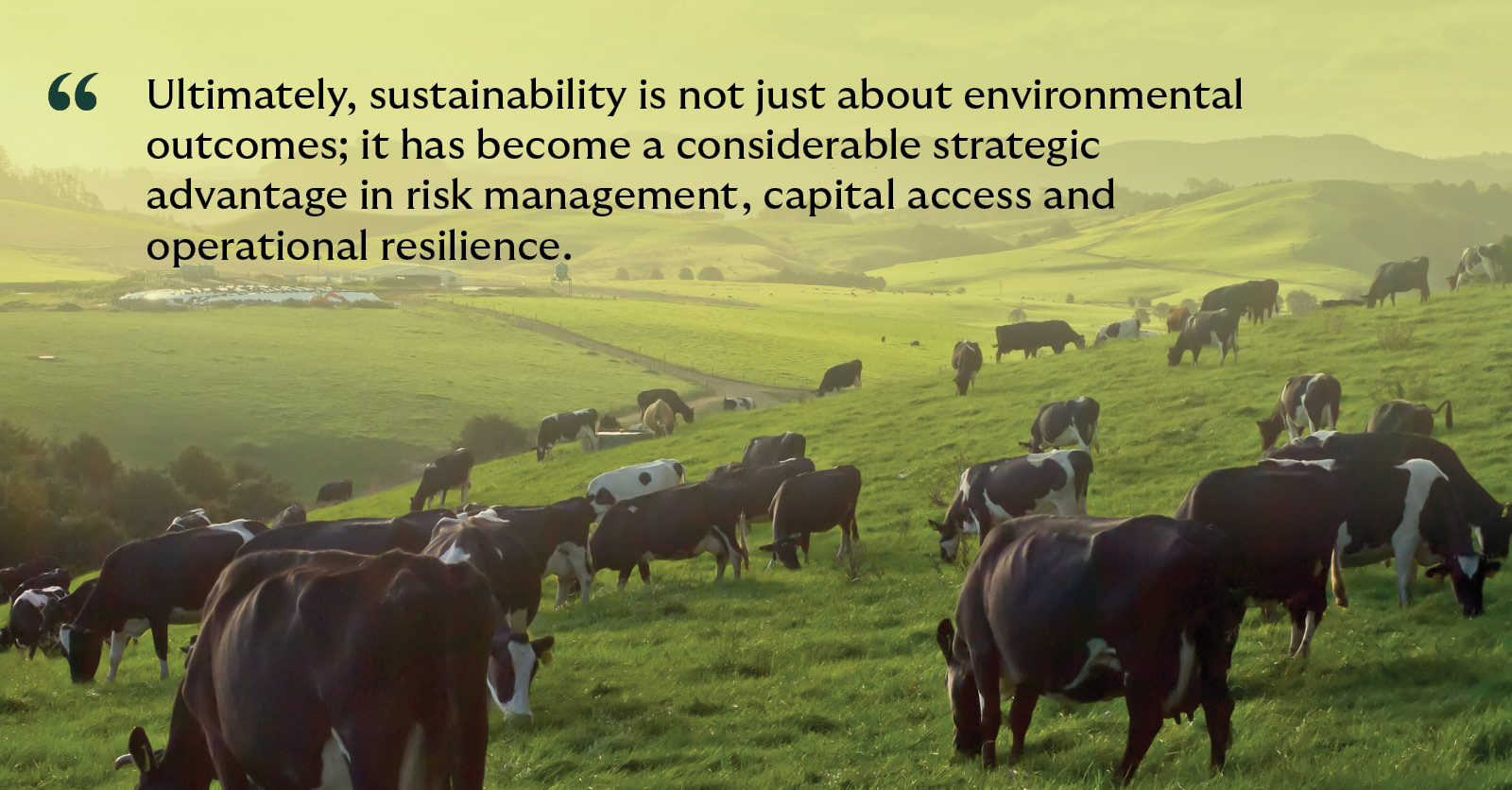
Ultimately, sustainability is not just about environmental outcomes; it has become a considerable strategic advantage in risk management, capital access and operational resilience.
How climate shocks are reshaping insurability
This increased climate volatility is significant as it’s changing insurability and pricing. Higher-frequency, systemic weather events tend to produce correlated losses across regions, driving claims volatility and increasing the cost of capital for insurers. That, in turn, tightens underwriting appetite, which for agribusinesses often means higher premiums and tighter terms. These impacts are particularly acute where risk controls such as water efficiency, resilient agronomy, fire preparedness and supply chain redundancy are weak. Sustainability practices therefore become risk controls that can improve loss experience and protect balance sheets, supporting better terms and capacity over time.
Turning data into risk advantage
Ensuring your business has strong data quality by maintaining robust data governance and leveraging new and innovative technology to improve data accuracy is essential for achieving optimal coverage. This could include IoT (Internet of Things) sensors for example, to allow for real-time monitoring of environmental conditions such as soil moisture, water levels, and rainfall intensity, as well as satellite and remote sensing tools that validate crop yield and land usage. Incorporating these technologies into farming operations provides clear insights into the factors that influence productivity, soil quality, plant health and pest and disease pressure1. This gives insurers accurate, up-to-date data to assess exposures more confidently, which in turn increases their appetite to place the risk.
Australia’s new sustainability reporting standards are resetting expectations
Regulatory scrutiny is also accelerating the integration of sustainability into agricultural risk frameworks. Under Australia’s recent mandatory sustainability reporting standards, entities are required to lodge a Sustainability Report with ASIC alongside their financial, directors’ and auditor’s reports. These disclosures must outline climate-related risks and opportunities that could materially affect cashflows, access to finance or cost of capital. Reporting is phased across three groups based on size and financial threshold: Group1 which began in January 2025, Group 2 from July 2026 and Group 3 from July 2027.
Why proactive climate governance attracts better capital and insurance terms
Whilst most agribusinesses won’t fall into Group 1, that doesn’t mean that they’re not affected. Large agribusinesses, retailers, processors and manufacturers that are already captured in phase 1 of the reporting waves are beginning to demand emissions, climate-risk and sustainability data from their suppliers. This includes farms and regional operators in Groups 2 and 3, so that those entities in Group 1 can complete value-chain assessments. This means that many agricultural businesses will need to prepare earlier than they expect. Those that get ahead on ensuring data transparency and accuracy, and sustainability reporting will strengthen their market position considerably.
As financial institutions continue to align with these sustainability principles, climate-conscious businesses are becoming increasingly attractive to insurers. Just as banks rewards progressive decarbonisation with improved access to loans, insurers can offer more favourable coverage terms to companies that demonstrate advanced climate risk management. Agribusinesses that proactively mitigate climate exposure across their supply chain build operational resilience and become far more attractive options to insurers. In turn, insurance acts as a strategic enabler of sustainability-aligned investment and long-term resilience.
Beyond traditional cover: new innovative solutions for an evolving risk landscape
Traditional indemnity policies such as farm pack or hail cover remain important, but they can involve slow claims processes and pay outs, which is problematic when businesses need fast access to cash after an adverse event. As the risk landscape becomes more volatile, agribusinesses are increasingly looking at additional tools that can sit alongside conventional insurance:
- Parametric (index) insurance: These polices pay out when a pre-defined, measurable trigger is met, for example, rainfall levels or a measured yield shortfall such as through the Howden Yield Shortfall insurance product. As these payments don’t rely on a loss assessor to visit the farm, funds can be released quickly to support cashflow and debt obligations.
- Weather derivatives or certificates: These work in a similar way, using weather or seasonal indictors to hedge revenue or input costs. They help buffer the financial impact of an unexpectedly difficult season and improve cashflow predictability.
- Blended risk programs: By layering retention with parametric solutions for region-wide events and traditional indemnity cover for asset damage, operators can reduce coverage gaps and create a more resilient overall program.
- Commodity and input hedging: Futures or over-the-counter (OTC) contracts (where available) allows producers to lock in prices for grain fuel, fertiliser or other key inputs which reduces margin shocks and supports covenant compliance during poor seasons.
Geopolitical and global supply chain shocks
The current global geopolitical instability adds another later of complexity for Australian agribusiness. The conflict in the Middle East has led to the severe disruption and restricted passage through the Strait of Hormuz, a critical shipping corridor for global energy flows where about 20% of global oil passes. These disruptions have driven sharp oil price spikes and contributed to higher freight and insurance costs. For Australian producers, this has a significant impact: fuel underpins almost every on-farm activity, including planting, spraying, harvest logistics, and irrigation.
This impact also affects fertiliser as a large share of global urea exports move through, or are affected by, Hormuz disruptions. Already elevated urea prices have again surged in line with higher energy costs. Australia relies heavily on imported urea, meaning that local growers face both critical price and supply availability risks, right at the time when winter cropping programs are gearing up and fertiliser demand is accelerating. These global shocks highlight just how exposed the sector is to forces extending well beyond the farm and why a broader approach to risk management is now absolutely essential.
Integrated risk management as the foundation of agri-resilience
The bottom line is that sustainability in Australian agriculture is no longer optional; it has become fundamental to risk management. Sustainable farming practices now underpin drought resilience, cashflow stability, insurability and readiness for emerging disclosure requirements. Innovative insurance solutions provide practical mechanisms to manage both climate-driven volatility and global supply chain shocks, and are most effective when supported by a strategic, integrated approach to risk management.
For agribusiness leaders, the action is clear: invest early in sustainability data, embed climate resilience into operational planning, and work proactively with your broker to build an integrated risk management plan. Those who take a forward-looking approach will secure better coverage terms, stronger market appetite and a more resilient business.
Get in touch today


1Application of Digital Technologies for Ensuring Agricultural Productivity, ScienceDirect, <https://www.sciencedirect.com/science/article/pii/S2405844023098092> (accessed 11 March 2026).