
 Austria
 Belgium
 Denmark
 Estonia
 Finland
 France
 Germany
 Greece
 Iceland
 Ireland
 Italy
Italy
 Liechtenstein
 Netherland
 Norway
 Poland
 Portugal
 Spain
Spain
 Sweden
 Switzerland
 Turkey
 United Kingdom
 Australia
 Fiji
Fiji
 Hong Kong
 India
India
 New Zealand
 Indonesia
 Japan
Japan
 Malaysia
 Philippines
 Singapore
 Thailand
 Brazil
 Chile
Chile
 Colombia
 Mexico
 Peru
Peru
 USA
USA
 Bahrain
 Israel
 Morocco
 Oman
Oman
 Saudi Arabia
 Tanzania
 UAE
UAE
Secondary psychological injury: the risk you can’t see, but absolutely can prevent
 Prefer us on Google


Secondary psychological injury is one of the most overlooked challenges in Australian workplaces. It won’t show up on an incident report, and it rarely makes headlines, but it becomes painfully visible in the moments when an injured worker starts to feel uncertain, excluded or left to fend for themselves.
New research from Monash University shows just how widespread this issue is and how much of it can be prevented with the right approach. For employers and insurers, this presents a real opportunity to rethink the way we prevent, promote and support people after an injury. If we get this right, we can significantly improve recovery outcomes and strengthen workplace culture at the same time.
Understanding the real problem
Secondary psychological injury isn’t an inevitable outcome of physical harm. It’s often the result of what happens after the injury - the way a worker is treated, the clarity of communication they receive, and how supportive the system feels, all play a major role in shaping their recovery. The Monash research makes this clear: in long-duration physical claims, almost one in three workers (30.9%) go on to develop signs of secondary psychological injury, highlighting how influential the post injury experience truly is. Secondary psychological injuries typically present as anxiety, sleep issues, overwhelm and loss of confidence, symptoms that can be just as debilitating as the original injury. Often the early stages are missed by the employer due to a disconnection from work, social support networks and even family.
A reactive approach to injury management can therefore indicate a limited understanding in the inherent requirements of the job, as well as missed opportunities to learn from near miss reports and feedback from frontline employees to improve work design. Whilst several factors can contribute to the recovery journey, building individual and organisational resilience will mitigate the risk of a secondary psychological injury. The surge in mental health service use shows just how sharply distress increases during the claims process: mental health medicine use jumps from 18.0% pre injury to 59.0% post injury, and service use rises from 11.2% to 29.3% in the two years following the injury.
Crucially, the research shows that positive early claims management plays a critical role in protecting a worker’s mental wellbeing. Workers who experienced negative interactions were statistically more likely to report ongoing psychological distress, with the study finding that poor early communication increased the likelihood of persistent negative mental health impacts more than fivefold.
Research from the TAC (Transport Accident Commission) in Victoria supports these findings. Programs such as Motivational Interviewing have demonstrated measurable benefits, with the research showing that participants were 2.36 times more likely to return to work at 13 weeks when their case manager had undergone this training.1
What’s driving these injuries?
Across interviews, lived experiences and claims data, a clear pattern emerged.
Uncertainty is the biggest trigger.
Workers struggle when they’re left wondering how they are going to recover and who is there to support them through what is often a traumatic experience:
- Will my claim be accepted?
- When will the payments come through?
- What happens next?
The moment clarity disappears, confidence does too and stress escalates quickly. When decisions about treatment, finances or work are made without them, it intensifies the sense of helplessness.
What makes the situation worse?
- The claims process itself can add pressure.
- Slow responses, repeated questioning, different assessors and impersonal communication all contribute to mounting stress. High turnover in claims teams often leaves workers feeling like they are starting from scratch.
- Pre-existing mental health conditions increase the risk.
- Workers with a prior history are exposed to a higher level of risk, although they are often reluctant to disclose it. Early support matters more than ever for this group.
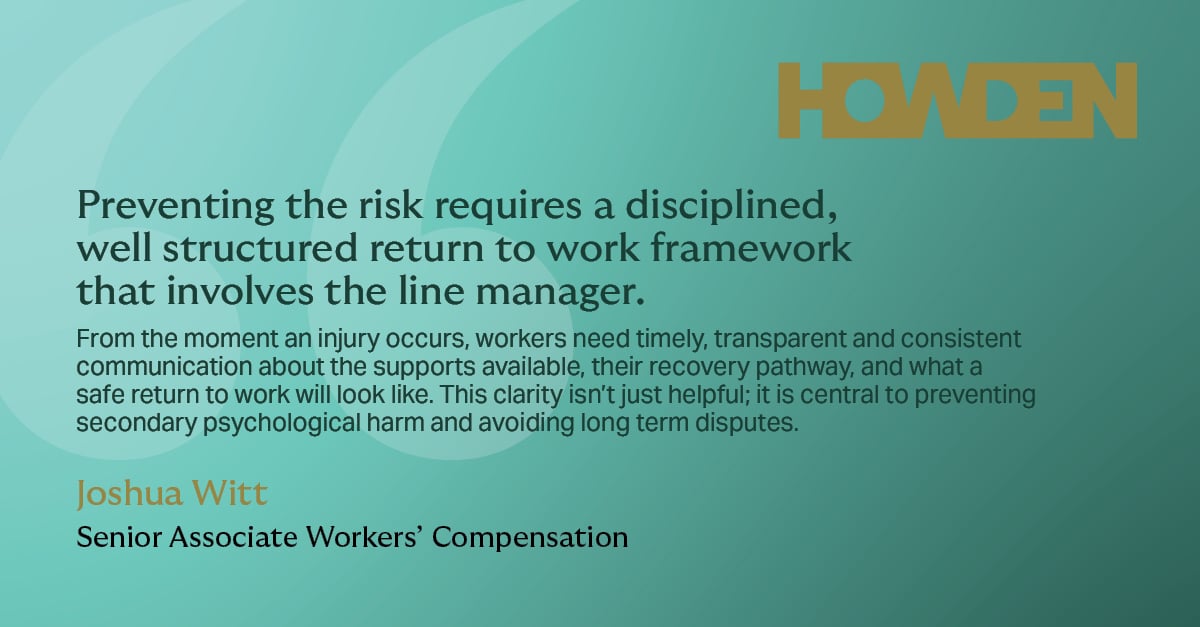
Managers are therefore instrumental in shaping the recovery journey.
In those early moments, a supportive line manager can make a profound difference, while a disengaged one can unintentionally make things worse. In high-risk organisations such as Police, our team has addressed this by implementing leadership training programs that establish clear KPIs for proactive and consistent officer contact.
Where can employers and insurers intervene most effectively?
The most encouraging finding in the research is that nearly all the major drivers of secondary psychological injury can be mitigated . Employers and insurers have more influence over recovery than they often realise and small shifts in approach can create meaningful differences for injured workers.
Here’s where to start:
- Provide clarity from day one
Uncertainty is one of the fastest ways to amplify stress. You can counter that with simple, proactive communication:
- Explain what’s happening in simple language, not policy jargon.
- Clearly outline the steps of the process so the worker knows what to expect, when, and from whom.
- Set clear expectations about timeframes, decision points and what information may be needed.
- Book regular check ins (weekly, especially early on) so the worker isn’t left waiting for updates or feeling forgotten.
- Stop making workers retell their story
Retelling an injury story isn’t just frustrating for the worker, it can be emotionally exhausting, instead:
- Create one shared source of truth. A central handover note or case summary ensures managers, HR, RTW (Return to Work) coordinators and the insurer are all working from the same facts.
- Ensure high-quality handovers are the norm, not the exception.
- Review internal processes for duplication, as many can be streamlined through better coordination.
- Equip and trust your line managers
Line managers are the closest connection an injured worker has to their workplace. Their influence is substantial.
Employers should therefore:
- Give managers an injury management roadmap that contains practical guidance on what to say, what to avoid, and how to support an employee through recovery.
- Integrate psychosocial risk management insights into their leadership briefings so that they are continuously implementing risk control or intervention strategies.
- Treat managers as early risk indicators. If support is wavering or confidence is low, bring in your RTW specialist early so the worker doesn’t absorb the uncertainty.
- Offer early psychological support
Psychological stress often begins long before a diagnosis appears, which is why early support matters.
Employers must:
- Make opt in counselling or psychology available to every claimant from the outset. In the instance of a high-risk incident (i.e. near-miss) mandate counselling as a risk control measure.
- Reinforce awareness of internal supports like EAP, peer support or wellbeing programs, by facilitating training that lifts the mental health literacy of your workforce population.
- Encourage open conversations about any pre existing mental health factors so the right support can be provided (and so the insurer is aware early).
- Collaborate on the return to work journey
A well-designed RTW plan does more than restore capacity, it rebuilds confidence.
Employers must:
- Co design duties with the worker so they feel meaningful.
- Fix any hazards or contributing factors before the worker returns on-site.
- Keep the worker connected socially, even before formal duties restart - a coffee with the team, a short visit to check in with them, or an invite to a team meeting can ease isolation and anxiety.
Connection is powerful. It helps people feel part of something, not sidelined by injury. The narrative is the key here, the more opportunity you have to shape a positive narrative, the less likely a worker will ruminate on adverse experiences when they return to work.
Why this matters
Secondary psychological injury lengthens claims, increases costs and slows return to work. But most importantly, it affects people at a time when they’re already vulnerable. It impacts their families, their finances, and their sense of identity. This insecurity within their ecosystem can exacerbate the narrative that is discussed in the home or within their community about “how they were treated” or “how they have constantly asked for the business to fix a problem that has now caused harm”.
The encouraging reality is that we can prevent much of this harm. By intervening early, building the mental health literacy of leaders and the broader workforce, and creating a clear, supportive claims experience, organisations can protect their people when they need it most and, ultimately, help build stronger, more resilient workplaces.
Get in touch today



1McMillan, J., Silva, D., Forgan, L. & Jones, K., Motivational Interviewing in TAC Claims Management: Evaluation Report 198. Victorian Transport Accident Commission / ISCRR, August 2018. Available at: https://research.iscrr.com.au/__data/assets/pdf_file/0008/1575809/198_Motivational-Interviewing-in-TAC-Claims-Management.pdf (Accessed: 17 February 2026).