
 Austria
 Belgium
 Denmark
 Estonia
 Finland
 France
 Germany
 Greece
 Iceland
 Ireland
 Italy
Italy
 Liechtenstein
 Netherland
 Norway
 Poland
 Portugal
 Spain
Spain
 Sweden
 Switzerland
 Turkey
 United Kingdom
 Australia
 Fiji
Fiji
 Hong Kong
 India
India
 New Zealand
 Indonesia
 Japan
Japan
 Malaysia
 Philippines
 Singapore
 Thailand
 Brazil
 Chile
Chile
 Colombia
 Mexico
 Peru
Peru
 USA
USA
 Bahrain
 Israel
 Morocco
 Oman
Oman
 UAE
UAE
 Saudi Arabia
 Tanzania
Employers in Asia step up investment in preventive healthcare as medical costs continue to rise
 Prefer us on Google


- Medical costs in Asia are projected to rise 11.4% (net of general inflation) in 2026, with 51% of employers expecting significant increases.
- Half of Asia employers have increased cost-sharing, alongside expanded flexible benefits and wellbeing initiatives.
- Health benefits are a key retention lever, with 70% of employees more likely to stay longer with an employer offering strong healthcare coverage.
Singapore, 3 March 2026 - Employers across Asia are strengthening their focus on preventative healthcare and flexible benefits design as medical costs continue to rise in 2026, according to our newly launched Asia Employee Health Infographic and Insights 2026 as part of the Changing Face of Global Employee Health report 2026 from Howden Employee Benefits.
Medical costs in the region are expected to remain above general inflation, putting upward pressure on employer healthcare budgets. Just over half of employers (51%) in the region anticipate significant medical cost increases in 2026, higher than the global average of 41%. To manage costs, 50% of employers have increased cost-sharing over the past year, and many are focusing on flexible benefits, prevention, and wellbeing initiatives.
Insurers in Asia expect cancer, cardiovascular disease, musculoskeletal conditions, and diabetes or metabolic conditions to be the main drivers of medical plan costs in 2026. Employers highlight mental health, cardiovascular disease and high blood pressure/hypertension as leading cost pressures, with obesity-related conditions, including GLP‑1 drugs such as Ozempic moving higher on the risk agenda.
At the same time, the findings underline how closely employees in Asia depend on employer‑provided healthcare. In the past 12 months, 43% of employees in Asia used only private healthcare for their most serious treatment, and 54% had employer‑provided private insurance cover the full costs.
Health benefits continue to play a central role in the employment relationship. Almost half (48%) of employees in Asia say health benefits are a factor when looking for a new role, while 70% of employees in Asia (compared to 60% globally) say they are more likely to stay longer with an employer if they have good health benefits, reinforcing the link between effective benefits design and talent retention.
Mental health is highlighted as one of the top health-related risks for employers in Asia and a significant driver of health plan costs. 38% of employees have sought treatment for mental health in the past year, primarily via medication or group therapy, and 28% used their employee health benefits or medical insurance to access this support.
Employers are responding by embedding a broader range of services, including Employee Assistance Programmes (63%), peer support or mental health champions (62%) and digital mental health platforms (51%). However, 18% of employees would still feel uncomfortable using employer‑provided healthcare for mental health needs, citing concerns around career impact, confidentiality, and workplace stigma.
AI is becoming a visible part of healthcare delivery across Asia. Nearly two-thirds (64%) of employees say they would trust AI being used in their healthcare journey today, and 38% report having experienced AI in their most recent care — including in areas such as treatment planning, remote monitoring and telehealth, and administration.
Employers are also looking ahead. Almost half (45%) say they would like to see AI-powered care adopted more widely, with particular interest in its use for claims processing and approvals, predictive analytics for high-cost claims, and diagnosis and screening.
Philip Samson, Regional Practice Leader, Asia, Howden Employee Benefits, said: “With medical costs across Asia expected to rise, employers are responding with a clear set of actions — increasing cost-sharing, expanding flexible benefits, and placing greater emphasis on prevention and wellbeing. Through our data and regional benchmarking, we are seeing organisations look more closely at what is driving claims and how benefits are structured, while ensuring healthcare remains a core part of their workforce strategy.”
Christine Wee, Regional Director, Asia, Howden Employee Benefits, said: “Our findings show that employees in Asia rely heavily on employer-provided healthcare, yet many still face barriers from cost or wait times, particularly in areas such as mental health. At Howden, we work closely with organisations across the region and see how strongly health benefits influence attraction and retention. With 70% saying they are more likely to stay longer with an employer that offers good health benefits, organisations recognise the importance of how benefits are structured and communicated to employees.”
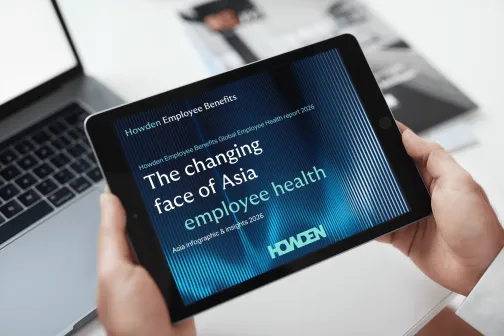
Download Asia Infographic and Insights 2026
Discover the latest benefits trends and strategies to optimise employee benefits design amid inflation and access challenges.