
 Austria
 Belgium
 Denmark
 Estonia
 Finland
 France
 Germany
 Greece
 Iceland
 Ireland
 Italy
Italy
 Liechtenstein
 Netherlands
 Norway
 Poland
 Portugal
 Spain
Spain
 Sweden
 Switzerland
 Turkey
 United Kingdom
 Australia
 Fiji
Fiji
 Hong Kong
 India
India
 New Zealand
 Indonesia
 Japan
Japan
 Malaysia
 Philippines
 Singapore
 Thailand
 Brazil
 Chile
Chile
 Colombia
 Mexico
 USA
USA
 Bahrain
 Israel
 Morocco
 Oman
Oman
 Saudi Arabia
 UAE
UAE
 Tanzania
Why Asia's healthcare challenge demands a new employer strategy
 Prefer us on Google


Rising medical costs and growing mental health needs are reshaping employer healthcare strategies across Asia.
According to Howden's Asia Employee Health Infographic & Insights 2026, Asia now has the highest projected medical trend globally, while employers identify mental health as the biggest health-related risk in 2026. At the same time, employees increasingly look to employers for meaningful healthcare support, making workforce health both a people priority and a business consideration.
Together, these trends are prompting organisations to think beyond simply managing healthcare costs and balance cost control with more proactive, sustainable health strategies.

Rising healthcare costs and growing mental health needs are no longer separate issues. Employers must understand how they influence one another to build sustainable health strategies.
Understand what's driving Asia's rising medical costs
Asia is projected to record a medical trend of 11.4% (net of general inflation) in 2026, the highest of any region and well above the global average.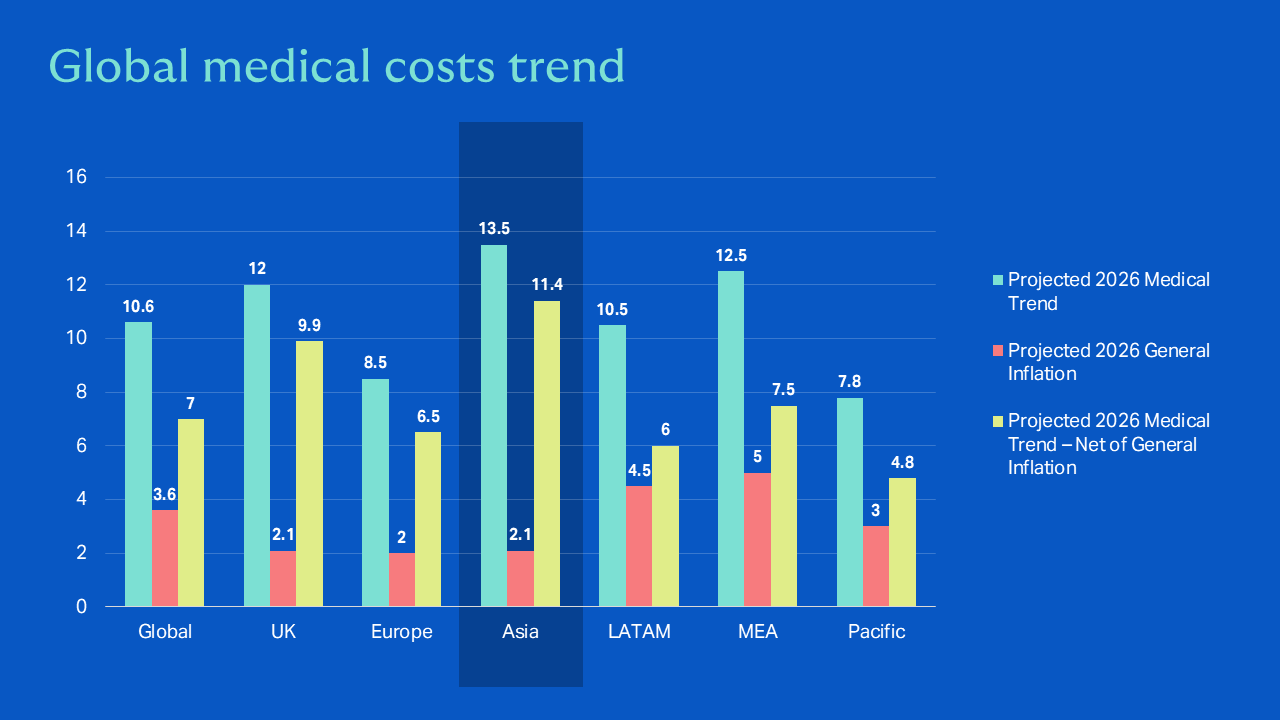
This reflects sustained post-pandemic healthcare utilisation, increasing chronic and critical disease, and wider adoption of advanced diagnostics and treatment. Cancer and cardiovascular disease continue to contribute significantly to claims severity and long-term healthcare costs.
Demographic and lifestyle changes are also adding pressure to Asia’s healthcare systems. Ageing populations in countries such as Singapore and Thailand, alongside the effects of unhealthy urban lifestyle habits, continue to drive demand for healthcare services.
Against this backdrop, more than half (51%) of employers expect medical costs to increase significantly in 2026.
Rising medical costs are no longer a short-term fluctuation. They reflect structural changes that employers must now plan for.
Balance rising costs with rising employee expectations
As healthcare costs continue to rise, employers are reviewing how healthcare benefits are funded and delivered. In Asia, there is no one-size-fits-all approach. Localised strategies remain essential given the region's diverse healthcare systems, workforce needs, and market conditions.
The report found that half (50%) of employers increased employee cost-sharing during the past year, exceeding the global average. Employers are therefore being asked to do more with healthcare benefits while managing significantly higher costs.

With medical costs across Asia expected to rise, employers are responding by increasing cost-sharing, expanding flexible benefits, and placing greater emphasis on prevention and wellbeing. Through our data and regional benchmarking, we are seeing organisations look more closely at what is driving claims and how benefits are structured, while ensuring healthcare remains a core part of their workforce strategy.
Recognise healthcare as part of the employer value proposition
Employees across Asia continue to rely heavily on employer-sponsored healthcare to access treatment.
More than half (54%) relied on employer-provided insurance to fully cover the cost of their most serious treatment during the past year. Fewer employees in Asia relied exclusively on private healthcare than the global average, reflecting differences in healthcare access across the region.
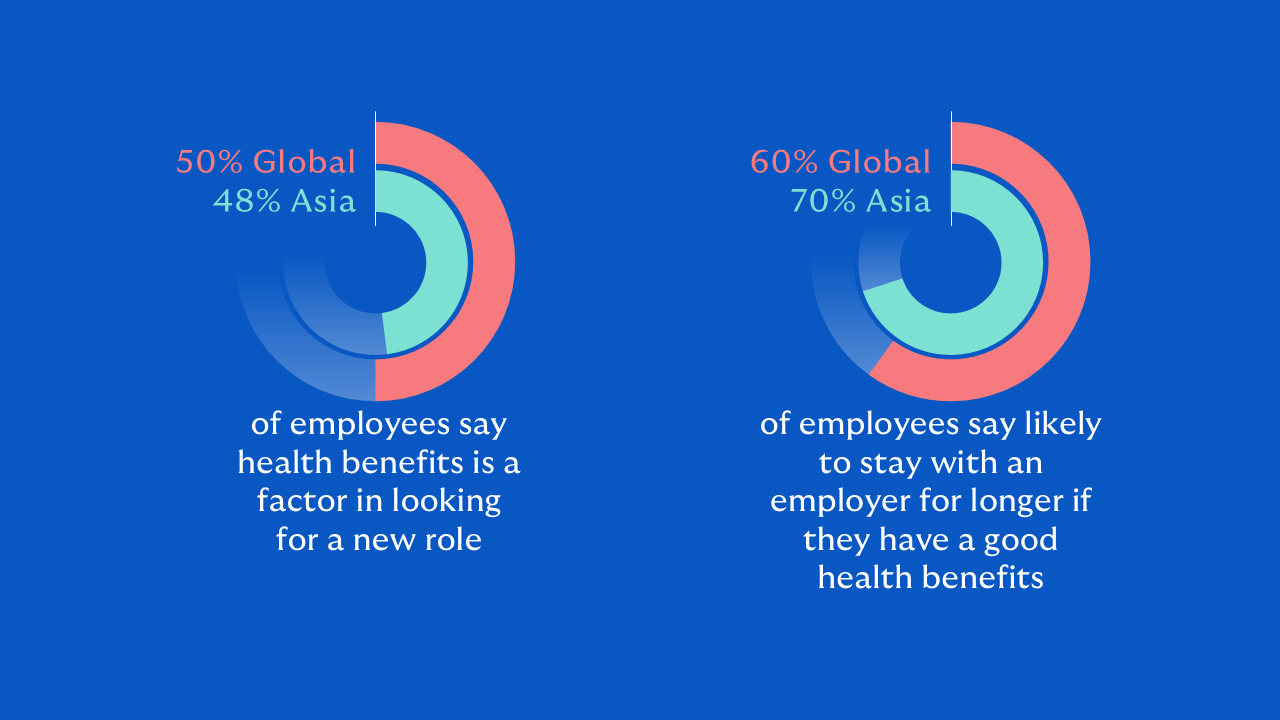

Our findings show that employees in Asia rely heavily on employer-provided healthcare, yet many still face barriers from cost or wait times, particularly in areas such as mental health. With 70% saying they are more likely to stay longer with an employer that offers good health benefits, organisations recognise the importance of how benefits are structured and communicated to employees.
These findings place employers at the centre of healthcare access for much of the workforce.
Embed mental health into business strategy
Alongside rising medical costs, employers now identify mental health as the biggest health-related risk facing organisations in 2026.
If organisations are to future-proof their wellbeing ecosystems, the most important structural shift is moving from wellbeing benefits ownership to wellbeing governance. This means treating mental health with the same rigour as physical safety or financial risk by:
- Integrating psychosocial risk into enterprise risk frameworks.
- Holding leaders accountable for psychological safety, not just engagement scores.
- Ensuring clinical oversight, quality assurance, and ethical data use.
- Designing integrated wellbeing ecosystems rather than isolated initiatives.
Mental health is also among the largest contributors to health plan costs. During the past year, 38% of employees sought treatment for mental health, primarily through medication and group therapy.
Demand has continued beyond the pandemic, driven by ongoing economic and workplace pressures. The most common workplace impacts include mental health-related absences (43%), burnout and wellbeing issues (40%), and increased requests for flexible work or leave (37%).
Dr. Suva says, "Mental health is now an expected part of employee healthcare. Supporting employees earlier benefits both workforce wellbeing and long-term healthcare outcomes."
Make healthcare benefits accessible through trust
While support is becoming more widely available, utilisation patterns suggest that access alone does not guarantee employees will seek care.
There is a gap between mental health need and actual utilisation of employer-provided support in the region. This is driven not by a lack of awareness or availability, but by a lack of psychological trust.
The report highlights this clearly. While 38% of employees in Asia sought mental health treatment during the past 12 months, only 28% accessed that care through employer-provided benefits or medical insurance.
In many Asian workplaces, employees assess the personal risk before seeking help. They question whether treatment will remain confidential, whether it will affect how they are perceived, or whether it could impact future career opportunities. Until those concerns are addressed, benefits are likely to remain underused regardless of investment.
Confidentiality and stigma continue to be significant barriers. Our data shows that 18% of employees would feel uncomfortable using employer-provided healthcare for mental health treatment, citing concerns about negative career repercussions, privacy, and workplace stigma.
Employees are more likely to seek support when they trust that their privacy will be protected and that doing so will not negatively affect their careers.
Shift from reactive care to prevention
Employers are increasingly shifting from reacting to illness toward prevention and early intervention.
The dominant mental health challenge in today's workforce is no longer episodic stress. It is chronic cognitive load, driven by constant change and digital acceleration. Supporting employees earlier can reduce the severity of illness, improve workforce wellbeing, and help manage future healthcare costs.
Technology is also becoming a larger part of healthcare delivery. Howden's Asia Employee Health Infographic & Insights shows that 64% of employees would trust AI being used in their healthcare journey, while 38% have already encountered AI in areas such as diagnosis, treatment planning, telehealth, or administration.
At the same time, traditional wellbeing strategies focused primarily on stress reduction or reactive support are proving insufficient. Medical evidence increasingly points to the importance of cognitive resilience – the ability to adapt, sustain attention, tolerate uncertainty, and recover psychologically.
64%
of employees would trust AI being used in their healthcare journey.
38%
of employees have already encountered AI in areas such as diagnosis, treatment planning, telehealth, or administration.

Turning healthcare insight into action
Rising medical costs and mental health pressures are changing what employers need from healthcare strategies.
Organisations that focus only on controlling costs risk are overlooking the workforce factors driving those costs in the first place. Those that combine prevention, employee trust, localised health strategies, and data-led decision-making will be better positioned to build healthier, more resilient workforces.
We help employers understand the trends shaping workforce health and translate those insights into practical strategies that balance cost, care, and clarity.

Download Asia Infographic and Insights 2026
Discover the latest benefits trends and strategies to optimise employee benefits design amid inflation and access challenges.