


 Austria
 Belgium
 Denmark
 Estonia
 Finland
 France
 Germany
 Greece
 Iceland
 Ireland
 Italy
Italy
 Liechtenstein
 Netherland
 Norway
 Poland
 Portugal
 Spain
Spain
 Sweden
 Switzerland
 Turkey
 United Kingdom
 Australia
 Fiji
Fiji
 Hong Kong
 India
India
 New Zealand
 Indonesia
 Japan
Japan
 Malaysia
 Philippines
 Singapore
 Thailand
 Brazil
 Chile
Chile
 Colombia
 Mexico
 Peru
Peru
 USA
USA
 Bahrain
 Israel
 Morocco
 Oman
Oman
 UAE
UAE
 Saudi Arabia
 Tanzania
Getting the triathlon bug and conquering the Outlaw
It’s 6:30pm on a drizzly late September day in 2019 and I’m about to take part in my first ever group swim coaching session with Ashford Tri Club.
I’m not a natural swimmer. Never have been. But somewhere in that past six months I thought it would be a good idea to learn how to do it properly, rather than my poor attempt at something resembling breaststroke that could just about carry me from one side of a holiday pool to the other.
I was terrified. I sat in the car with tears in my eyes thinking that I couldn’t do it. Eventually I was bullied into getting out of the car and into the pool, and it actually went better than I expected.
Fast forward around 18 months and I took part in my first ever triathlon - a Half Ironman distance event at Holkham Hall in Norfolk – not exactly an entry level triathlon, but one which would most certainly give me the ‘bug’ to really get into this enjoyable but crazy sport. I followed this up with another over the same distance eight weeks later, taking 20 minutes off my previous time and by then I was hooked.
A couple of sprint Tri’s followed, and then one evening after a few glasses of wine - usually my precursor to signing up for ridiculous challenges - I was persuaded to join 11 other equally bonkers individuals from the Tri Club in taking on a race called Outlaw.
Outlaw is essentially an “Ironman” - or Long/Full Distance triathlon to give it its correct name. t’s insane. It’s bonkers. And at the point I signed up, I also thought it was impossible.
Firstly, you swim 2.4 miles - not in a nice safe, clean swimming pool, but in open water. In new money that’s 3,800 metres, and you’re often surrounded by ducks or weird things brushing your feet.
Then you wriggle out of your wetsuit and, if you don’t feel too lightheaded or seasick, you stagger through transition, eating as you go, to try and locate your bike and then set off for a mere 112 miles in the saddle.
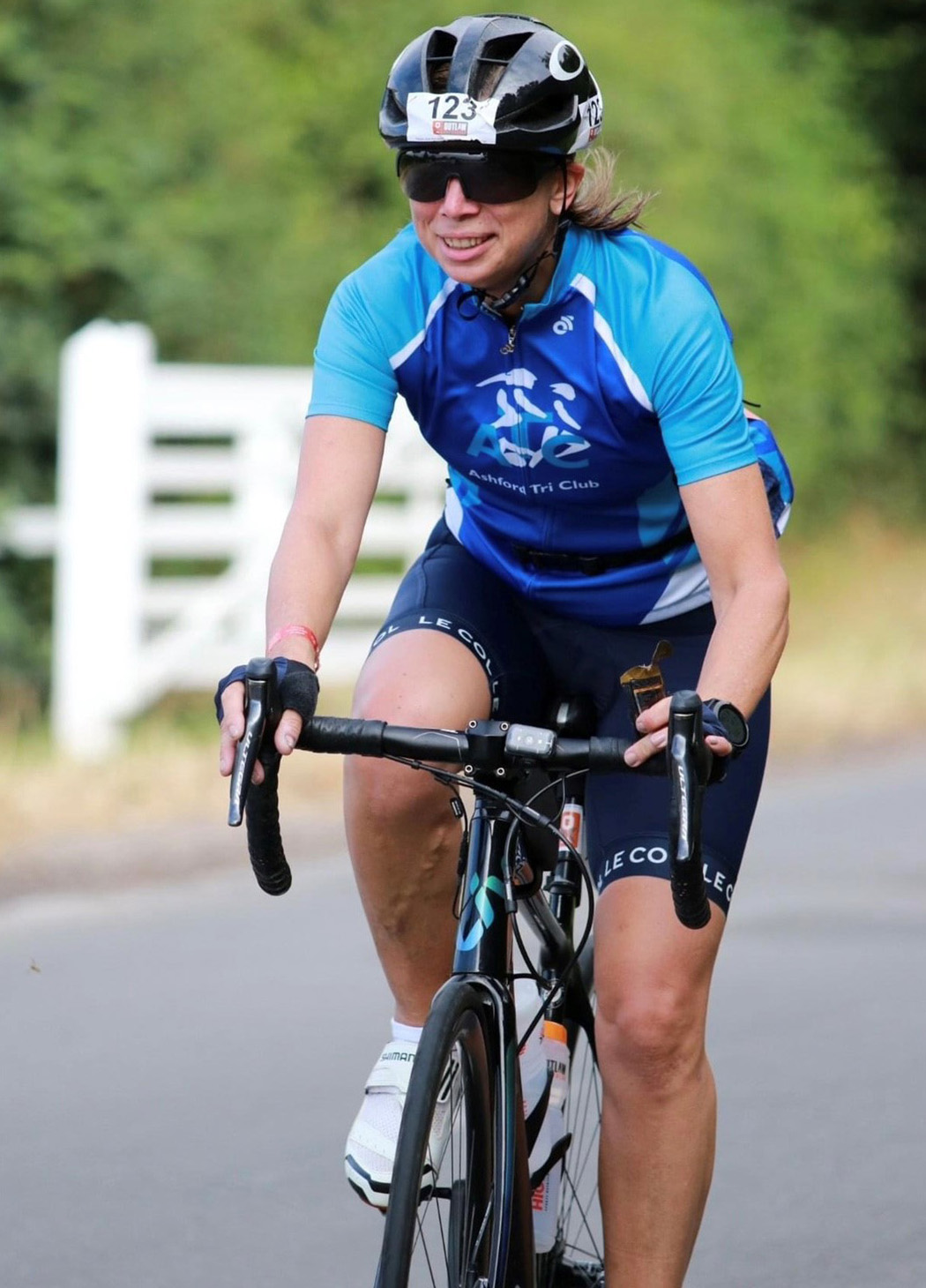
If your legs are still working, on returning to transition for a second time, you dismount without falling off and then continue eating while you change into your trainers and exit transition for part three of your race: 26.2 miles of running; or in other words, a marathon.
Now I came to triathlons having taken up running aged 41 and having no background in either swimming or cycling - unless you count my sole mode of transport as a teenager many, many years ago!
As a runner who has now completed a few marathons, you train for 16 weeks to take on that distance alone. The final 10 days you taper off the training and wrap yourself in cotton wool so as not to overexert or damage yourself in any way to ensure you reach that start line in tip-top form, with fresh legs and feeling strong.
So, the mere fact that to conquer a full distance triathlon means you have to effectively swim the equivalent of Bristol Channel before cycling the length of the M4 corridor to London before running the London Marathon itself is completely alien to all I’ve experienced as a competitor in a single disciplined sport.
Nonetheless, six months of training ensued, and my life became a plethora of swim/bike/run/strength training, brick sessions (bike and run in the same set!) and eating a ridiculous amount of calories just to stay out of deficit.
Amongst all of this I had to deal with my fear - no, terror - of swimming in open water as well as undertaking more miles on a bike than I knew possible in order to stop that feeling of discomfort every time I sat down on a chair!
I didn’t make it easy for myself. As well as training for Outlaw, I also threw in the Brighton Marathon for good measure (hell, why not!), as well as Ride London 100, which as a major event for many, was weirdly just a long training session for me.
Fuelling strategies and nutrition experimentation were vital, as well as working out how many energy gels I would need versus how many my stomach could physically tolerate.
When the day arrived, a 4am alarm was followed by a nervous breakfast before the 6am siren to mark the melee that is the mass swim start. Think of being thrown around in a washing machine with 1,000 other wetsuit-clad adrenaline junkies all vying for position and trying to avoid being kicked in the head, and that just about sums it up!
My swim actually went remarkably well. Anticipating a 1 hour 40-minute time, I exited for transition 15 minutes ahead of schedule - the resultant high helping me fly through the first third of the bike leg. By 80 miles I was hurting but I was still going strong. By the final loop however, the gentle breeze had turned into a mini tornado and even staying upright was a challenge, let alone the exhausting feat of pedalling for all I was worth into a head wind at times.
Finally, back into the second transition, I dismounted with a smile still just about on my face and put my trainers on knowing that now it was just me, my feet and my sheer determination that would get me through to the end.
I started the run leg at 2:15pm. At this stage, finishing (preferably in daylight) was the aim. Despite some kit issues and sheer exhaustion at times, the on-course support was immense, and I managed not only to finish before it was dark, but to run a sub-5-hour marathon to complete my first full distance triathlon in a time of 13 hours and 42 minutes.
To be honest getting round the course was my objective, but to say I was proud was an understatement. I sobbed as I crossed the finish line, only for the lovely volunteer I had collapsed on to take one look at me, decide I didn’t need medical attention and send me on my way to collect my medal.
For many, an Ironman is a “one and done” and I rather thought I’d be the same...
Read part two of my blog and part three to find out what’s next on my triathlon journey.