
 Austria
 Belgium
 Denmark
 Estonia
 Finland
 France
 Germany
 Greece
 Iceland
 Ireland
 Italy
 Liechtenstein
 Netherland
 Norway
 Poland
 Portugal
 Spain
 Sweden
 Switzerland
 Turkey
 United Kingdom
 Australia
 Fiji
 Hong Kong
 India
 New Zealand
 Indonesia
 Japan
 Malaysia
 Philippines
 Singapore
 Thailand
 Brazil
 Chile
 Colombia
 Mexico
 Peru
 USA
 Bahrain
 Israel
 Morocco
 Oman
 UAE
 Saudi Arabia
 Tanzania

Guaranteed Minimum Pensions (GMP) projects
Supporting you through every stage of your Guaranteed Minimum Pension (GMP) project
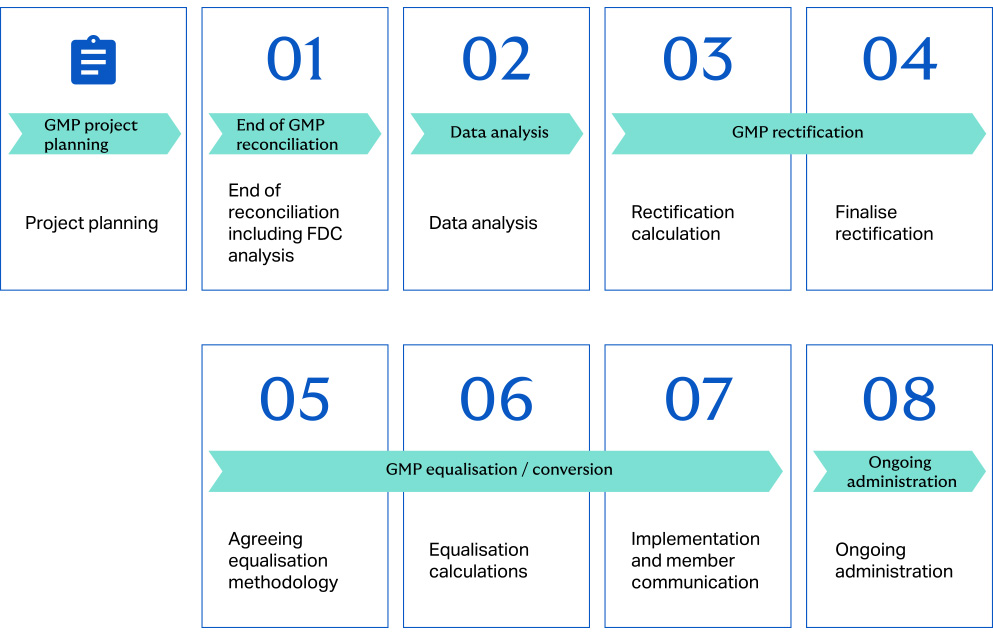
The legal position is clear. Guaranteed Minimum Pension (GMP) equalisation needs solving. Pre-requisite steps are GMP reconciliation and GMP rectification. Where these have not been completed, they should be considered together with GMP equalisation as part of the overall GMP project.
Getting your GMP project right
For trustees or sponsors of pension schemes, there are three stages to the GMP project:
- GMP reconciliation – agree GMP amounts with HMRC
- GMP rectification – correct members’ benefits where GMPs have changed as a result of GMP reconciliation
- GMP equalisation – making sure all members have benefits at least as valuable as if they had been the opposite sex
Guaranteed Minimum Pension explained
Every GMP project is different, but each follows the same core stages.
Our experienced team can support the whole project or step in wherever you need us most.
The diagram below sets out how the different stages of the GMP pension project fit together. Our experienced team, including a GMP specialist unit, will help you get your GMP project done. We are equally comfortable taking your project through from start to finish or picking up a subsection, whatever best meets your requirements.
GMP reconciliation
The first step in your GMP project is to finish GMP reconciliation.
Some schemes will have completed this already. Others have been waiting for HMRC to issue 'Final Data Cuts' to compare their GMP records with HMRC’s records to check they marry up before signing off the GMP Reconciliation.
We've supported schemes through GMP reconciliation projects of all sizes. We'll help compare your records with HMRC's data, investigate any differences and support you through to completion.
Common questions
GMP is the minimum pension entitlement for members of contracted-out salary related pension schemes (COSRs) who, between April 1978 and April 1997, in return for paying lower National Insurance Contributions, gave up part of their entitlement to the State Earnings Related Pension Schemes (SERPS) and its successor, the State Second Pension (S2P).
The underlying principle is that COSRs will provide members (and widows/ers) with pensions at ‘GMP age’ at least equivalent to what they would have earned under SERPS. GMP entitlement ages are 65 for males and 60 for females despite changes in the State Pension Age.
Since April 1978 pension schemes have been able to contract out and in return for providing a minimum level of benefits (i.e. a GMP) employers and members were allowed to pay lower rates of National Insurance. This all sounds fine in principle, but as might be expected there is a good deal of administrative work that goes with contracting out, involving the employer, pension administrators and the National Insurance Contributions Office (NICO) of the Inland Revenue. In particular administrators need to make sure the GMP recorded under the scheme aligns with that held on NICO’s records. This is known as GMP reconciliation.
Howden provides trustees and sponsors of pension schemes all the support and guidance they may need when it comes to delivering their GMP projects.
GMP reconciliation is a project to ensure the GMP liability on the scheme records agrees with that held by HMRC.
A GMP reconciliation project can be complex and take a significant amount of time to complete, typically in excess of 12 months.
That depends on your scheme.
The amount of work involved is largely driven by the number and complexity of any differences between your records and HMRC's. We'll assess your starting position and give you a clear view of what's involved before work begins.
Costs vary from scheme to scheme.
We'll start by producing a State of Play report to assess where your scheme stands. From there, we'll recommend the level of work needed, balancing cost, risk and your preferred approach to resolving any differences.
Data gap analysis
Before moving on to rectification, it's worth checking the quality of your member data.
A data gap analysis helps identify missing or incomplete information so it can be addressed before equalisation begins.
GMP rectification
Once reconciliation is complete, any changes needed to member records can be applied.
Our streamlined approach helps reduce manual work, minimise errors and maintain a clear audit trail throughout the project.
GMP equalisation and conversion
Every scheme is different. That's why there's no one-size-fits-all approach to GMP equalisation.
We'll work with you to choose the right method for your scheme before carrying out the calculations and providing clear reporting throughout the project.
We'll also provide the documentation you need to support future activity, including buy-ins and buyouts where appropriate.
Communication with members
Clear communication with members is an important part of every GMP project.
We'll help explain complex changes in plain English, making sure members understand what's happening and why.

Talk to us
Need support with your GMP project? Talk to our team about how we can help.